Sciatica PRO+ Official Website › Blog › Alpha lipoic acid
Alpha Lipoic Acid At 400 mg Against A 600 mg Trial Dose
One ingredient on this panel has a large, coherent body of human research behind it, and one number in that research is quoted everywhere: 600 mg a day. This label prints 400. Here is where 600 came from, what 400 is, and what neither of them achieved.
- The oral trials settled on 600 mg a day. Three separate studies used it, over periods from five weeks to four years.
- SYDNEY 2 tested 600, 1,200 and 1,800 mg and found the higher doses brought more nausea without more benefit.
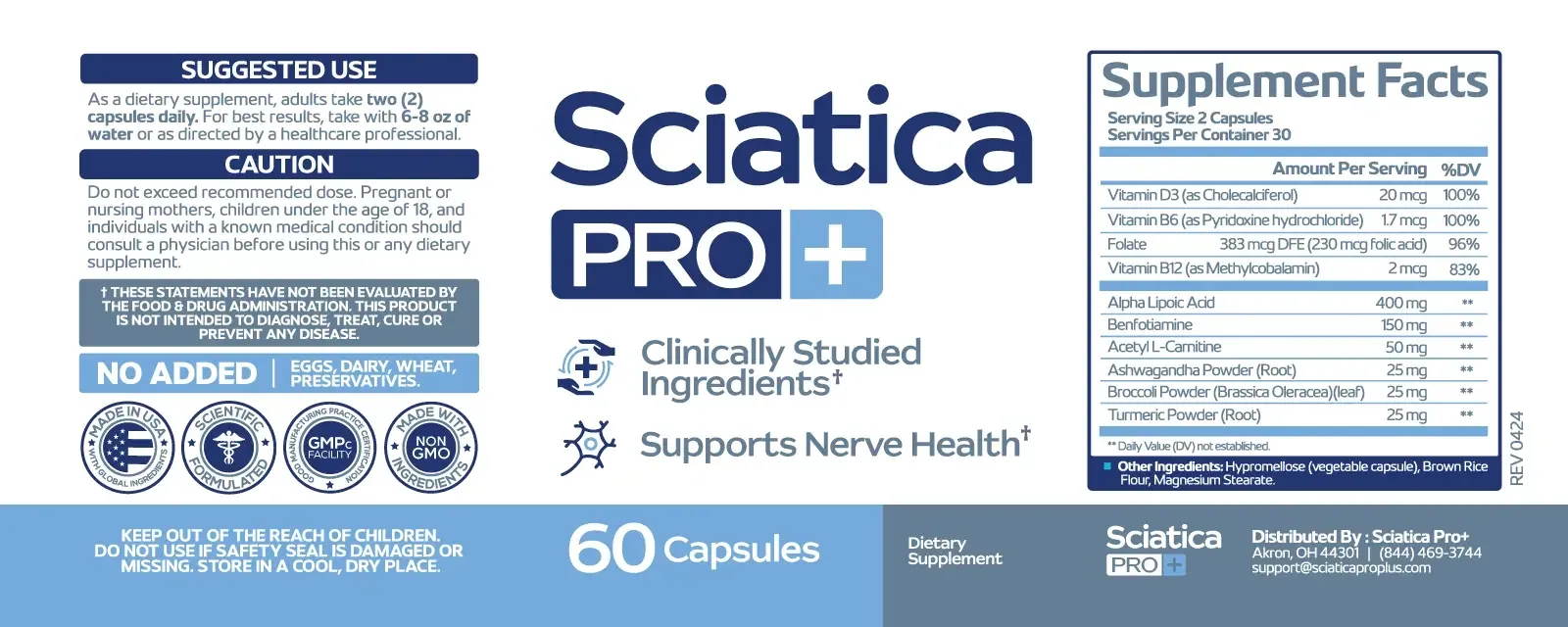
- This label prints 400 mg, which is two-thirds of the trial dose and the same order of magnitude.
- No trial has been run at 400 mg, so it is untested rather than disproven.
- What even 600 mg achieved was improvement in symptom scores. No study has shown structural nerve regeneration.
- It can lower blood glucose, which matters alongside diabetes medication.
What alpha lipoic acid is
Alpha lipoic acid is a small sulphur-containing compound the body makes in modest amounts and uses as a cofactor in the mitochondrial reactions that turn fuel into energy. It is also an antioxidant, and an unusual one: it works in both watery and fatty environments, where most antioxidants are restricted to one.
That dual solubility is where the research interest started. A compound able to operate in both compartments, and to regenerate other antioxidants once they have been used, is an obvious candidate anywhere oxidative stress is part of the problem.
Nerve fibres damaged by years of high blood glucose are one such place, and that is the population almost every trial recruited from.
The three trials that set the dose
For a supplement ingredient, the oral programme is unusually coherent. Four references cover most of what anyone quoting this ingredient is drawing on.
| Trial | Oral dose | How long | What it measured |
|---|---|---|---|
| ALADIN III | 600 mg a day | Seven months | Symptom and impairment scores in diabetic polyneuropathy. |
| SYDNEY 2 | 600, 1,200 and 1,800 mg a day | Five weeks | Symptom scores across three doses against placebo, which is what makes it the dose-ranging study everyone quotes. |
| NATHAN 1 | 600 mg a day | Four years | Progression over the longest follow-up in the programme. |
| The 2023 meta-analysis | Pooled, mostly 600 mg | Varies | Whether the symptom improvements hold up when the trials are combined. |
Every dose above is what the trial administered. None of it is a statement about this capsule or any other.
Read them together and a pattern appears. The same dose recurs, the outcome measured is usually a symptom score rather than a nerve measurement, and the durations range from weeks to years without the dose changing.
That consistency is why 600 mg is not an arbitrary round number. It is the amount an entire field converged on after testing alternatives.
Why 600 mg, and not more
This is the part most labels leave out, and it is the most interesting thing in the literature. SYDNEY 2 did not simply test one dose against placebo. It ran three: 600, 1,200 and 1,800 mg a day.
All three improved symptom scores against placebo. What separated them was tolerance. Nausea rose with dose, and the higher arms bought no additional benefit for it, so the trial concluded that 600 mg once daily offered the best balance of benefit against adverse effects.
Why that matters when you read a label
It means more is not better for this ingredient, which is unusual in a category where the implied rule is that a bigger number is a better product. A label printing 1,200 mg of alpha lipoic acid would not be twice as good as one printing 600. It would be the arm of SYDNEY 2 that produced more nausea.
It also means the ceiling is known. When an ingredient has a tested top end, the interesting question about any label becomes how far below it sits rather than how far above.
What 400 mg is, and what it is not
With the trial dose fixed at 600 mg, the arithmetic on this panel is simple and worth seeing laid out.
| The trial dose | This label | The gap | |
|---|---|---|---|
| A day | 600 mg | 400 mg | 200 mg short, or two-thirds of the trial amount |
| A week | 4,200 mg | 2,800 mg | 1,400 mg short |
| A 30-day bottle | 18,000 mg | 12,000 mg | 6,000 mg short |
| As a share | 100% | 67% | The same order of magnitude, which is unusual here |
| Trials run at 400 mg | — | None | So 400 mg is untested rather than disproven |
Arithmetic on the printed panel against the dose the oral trials settled on. The last row is the one that matters most and is the easiest to skip.
The last row is the honest core of this article. Nobody has run a trial at 400 mg a day, so there is no result to report. That is not the same as a negative result, and it is not a licence to assume two-thirds of the dose delivers two-thirds of the effect either.
Dose-response curves are not straight lines. SYDNEY 2 demonstrated that at the top end, where tripling the dose added nothing. What happens at the bottom end, below 600 mg, has not been mapped.
See the full Sciatica PRO+ panel and the three packs
Ten ingredients with an amount printed against every one, so each can be held against the dose its own research used. Two capsules a day, 60 to a bottle, and 60 days from purchase to decide.
Packs from $158 · six bottles for $294 · 60-day money-back guarantee
Order Sciatica PRO+ On The Official WebsiteTwo capsules a day · 60 per bottle · lot SCI-26/GE-2574
The case for 400 mg being a serious number
This desk sells the product, so the argument in its favour is set out and then the argument against it, and you can weigh both.
- It is the same order of magnitude as the tested dose. Two-thirds is not a rounding error, and it is not the token quantity that appears further down this panel.
- The largest amount went to the best-evidenced ingredient. On a formula with ten rows, the decision about where to spend the weight is a real decision, and this one went to the ingredient with the strongest nerve literature rather than to the one with the most fashionable name.
- The amount is printed. You can perform the comparison in this article because the panel lets you. A shared blend total would make every sentence here impossible to write.
- Nausea is the dose-limiting effect, and it is dose-related. A smaller amount is easier to tolerate, which matters for something judged over months.
- Two capsules carry it. At 400 mg a serving, the ingredient fits a two-capsule routine without the pill burden a 600 mg target would add on top of nine other rows.
The case against it
And the other side, which is shorter and harder to answer.
- 600 mg is the dose with the evidence. If the research is the reason you want this ingredient, the research used 600 mg, and 400 is not it.
- A single-ingredient capsule at 600 mg costs a fraction of a ten-ingredient formula. Anyone whose interest is alpha lipoic acid specifically can buy the tested dose cheaply without this website's involvement, and saying so is more useful than pretending otherwise.
- Nobody knows what 400 mg does. The honest position is an absence of evidence in either direction. The results timeline is built on that assumption rather than on a promise.
What even the trial dose achieved
This section matters more than the arithmetic above, because it sets the ceiling on what the whole discussion is about.
A 2023 meta-analysis of the oral trials found improvement in symptom scores: the burning, prickling and numbness people report, measured on standard scales. That is a real finding in a real population, and it is modest.
What has not been shown is structural repair. A 2026 critical review of alpha lipoic acid and benfotiamine makes the point directly: no study has demonstrated nerve regeneration. Symptoms improving and nerves rebuilding are different claims, and only the first has support.
It is also worth repeating who was studied. These were people with diabetic polyneuropathy, a metabolic problem. Sciatica is a mechanical one, and a finding in the first population does not transfer to the second. The article on what sciatica is covers why.
Alpha lipoic acid can lower blood sugar. If you take medication for diabetes, that is a conversation to have with your prescriber before the first capsule rather than after an unexpected low. There are also case reports of it triggering insulin autoimmune syndrome, severe hypoglycaemia in people who do not have diabetes at all. Rare, and documented, which is why it is printed here rather than left out.
Blood glucose, and two rarer things
The box above covers the main one. Two smaller points complete the picture.
Nausea is the effect that limited the dose in the trials, and it is the commonest reason people stop. Taking the capsules with food usually settles it; at 400 mg it is less likely than at the 600 mg the trials used.
And the interaction question is not only about diabetes medication. Anything that affects blood glucose belongs in the same conversation. The side effects page works through the whole panel a row at a time rather than only this ingredient.
How to hold this against a bottle
Four things to check on any label carrying this ingredient, in the order worth checking them.
- Is an amount printed at all? Inside a proprietary blend the figure is unknowable and the rest of these questions cannot be asked.
- How does it compare with 600 mg? That is the only number the literature offers, so it is the only yardstick there is.
- Is it a daily total or a per-capsule figure? A panel states a serving. Two capsules at 200 mg each and one capsule at 400 mg are the same daily amount described two ways.
- What else is in the bottle, and at what amounts? An honest 400 mg row sitting beside eight token ones tells you something about the formula as a whole, which is what the supplement facts page is for.
For what it is worth, applied to this panel: 400 mg printed, a serving of two capsules, and a mixed picture underneath it. That is the trade, stated in one sentence.
References
- Ziegler D, Ametov A, et al. Oral treatment with alpha-lipoic acid improves symptomatic diabetic polyneuropathy: the SYDNEY 2 trial. Diabetes Care. 2006;29(11):2365-70. PMID 17065669. https://pubmed.ncbi.nlm.nih.gov/17065669/
- Ziegler D, Hanefeld M, et al. Treatment of symptomatic diabetic polyneuropathy with the antioxidant alpha-lipoic acid: a 7-month multicenter randomized controlled trial (ALADIN III Study). Diabetes Care. 1999;22(8):1296-301. PMID 10480774. https://pubmed.ncbi.nlm.nih.gov/10480774/
- Ziegler D, Low PA, et al. Predictors of improvement and progression of diabetic polyneuropathy following treatment with alpha-lipoic acid for 4 years in the NATHAN 1 trial. J Diabetes Complications. 2016;30(2):350-6. PMID 26651260. https://pubmed.ncbi.nlm.nih.gov/26651260/
- Hsieh RY, Huang IC, et al. Effects of Oral Alpha-Lipoic Acid Treatment on Diabetic Polyneuropathy: A Meta-Analysis and Systematic Review. Nutrients. 2023;15(16):3634. PMID 37630823. https://pubmed.ncbi.nlm.nih.gov/37630823/
- Salman M, Ashraf H, et al. Hypoglycaemia in a non-diabetic patient due to alpha-lipoic acid-induced insulin autoimmune syndrome with HLA-DRB1 04:03:01G. BMJ Case Rep. 2026;19(7). PMID 42493219. https://pubmed.ncbi.nlm.nih.gov/42493219/
- Ciubotaru A, Grosu C, et al. Alpha-Lipoic Acid and Benfotiamine in Diabetic Peripheral Neuropathy: A Critical Review of Mechanistic Rationale and Clinical Evidence Within a Nutritional Therapeutic Framework. Nutrients. 2026;18(10). PMID 42196997. https://pubmed.ncbi.nlm.nih.gov/42196997/