Sciatica PRO+ Official Website › Blog › What sciatica is
What Sciatica Actually Is, And What A Supplement Cannot Do About It
This website sells a nerve-health capsule named after a condition it does not treat. The condition comes first: what sciatica is, how it is diagnosed, what usually happens to it, and why a capsule sits outside all of that.
- Sciatica is a symptom, not a diagnosis: pain along the sciatic nerve caused by something pressing on a nerve root.
- The usual causes are a herniated lumbar disc and spinal stenosis, a narrowing of the nerve's canal.
- It is diagnosed clinically, from history and examination. Imaging is not routinely needed early on.
- Most cases improve over weeks to months with conservative care.
- Three symptoms make it an emergency: progressive leg weakness, saddle numbness, and new bladder or bowel changes.
- Nothing taken by mouth relieves a compression. Nerve nutrition and nerve compression are separate subjects.
Sciatica is a symptom, not a diagnosis
The sciatic nerve is the largest in the body. It forms from roots leaving the lower spine, runs through the buttock and down the back of the leg, and supplies much of the leg below the knee. Sciatica is the name for pain following that route.
The word describes where the pain is felt rather than what is causing it, which is why treating it as a condition in its own right leads people astray. The New England Journal's review starts there: the pain is a consequence, and the question is what is pressing on the root.
The two causes that account for most of it
A herniated lumbar disc is the commonest. Each disc has a tough outer ring and a softer centre, and when the centre pushes through it can sit against a nerve root leaving the spine. The compression is part mechanical and part chemical: the displaced material is inflammatory where it touches the nerve.
Spinal stenosis is the other, and more common with age. The canal the nerve runs through narrows through thickened ligament, arthritic change and disc settlement, and the classic account is leg pain that comes on with walking and eases on sitting or leaning forward.
Less common causes exist and matter clinically, which is why a particular leg needs examining rather than reading about.
Why the word gets used loosely
In ordinary speech sciatica has stretched to mean almost any pain travelling from the back into the leg, and a search returns stretches, belts, creams and capsules. A product named after a symptom implies an address to every cause of it, and no supplement addresses any of them.
How it is actually diagnosed
The diagnosis surprises people. A BMJ clinical review is explicit that it is clinical: made from the history and the examination, not from a picture. Imaging is reserved for cases that are not settling, where surgery is being considered, or where something in the examination points at a cause that needs finding quickly.
| What a clinician does | What it is looking for | Why imaging is not first |
|---|---|---|
| Asks where the pain travels | Pain below the knee in a nerve root pattern separates sciatica from ordinary low back pain. | The pattern is information a scan cannot supply. |
| Raises the straight leg | Reproducing the leg pain suggests a nerve root is irritated. | Done in seconds, with nothing to book. |
| Tests power, reflexes and sensation | Which root is involved, and whether anything is weakening. | Weakness changes the plan. A picture of a disc usually does not. |
| Asks about bladder, bowel and saddle sensation | The emergency pattern, ruled in or out before anything else. | Urgent regardless of what any scan shows. |
| Waits, in most cases | Whether symptoms settle on their own. | Disc bulges show up on scans of people with no pain at all. |
Drawn from published clinical reviews. It describes what assessment involves; it is not a substitute for having one.
Imaging sits later because a scan of a symptom-free population turns up disc bulges in a large share of people. A picture can confirm what the examination suspected, and it can equally produce a finding that explains nothing and worries everyone.
For a plain-English reference away from a seller, MedlinePlus is the place to start.
What usually happens next
The most useful single fact about sciatica is that most of it settles. Not all, and not always quickly, but favourably enough to change how the first few months are managed.
| Roughly when | What tends to happen | What care usually looks like |
|---|---|---|
| The first days | Pain is often at its worst and movement is limited. | As active as the pain allows, not bed rest. |
| Weeks one to six | A large share of people improve substantially. | Movement, time, and whatever pain control a clinician advises. |
| Weeks six to twelve | Improvement continues for most, more slowly. | Physiotherapy or a structured exercise programme is common. |
| Past three months | A minority still have significant symptoms. | Where injections and surgical referral start being discussed. |
| A year out | Surgical and non-surgical groups converge in the trial data. | So the decision is rarely urgent unless something else says so. |
A general pattern from the clinical literature, not a prediction about any individual. Worsening symptoms need reassessing rather than waiting.
Improvement over the first weeks is expected rather than remarkable, so anything started during that window will appear to work whether it did anything or not. That is why testimony about sciatica is close to worthless as evidence.
Guideline summaries put movement, time and assessment at the centre of care. Staying as active as the pain allows is the mainstream position, and not what most people expect to be told.
- Progressive or severe weakness in the leg
- Numbness around the groin, buttocks or inner thighs (a saddle pattern)
- Any new loss of bladder or bowel control, or of sexual function
Together these can indicate cauda equina syndrome, where the nerve roots at the base of the spine are compressed. It is assessed in hours, not watched for a week, and delay costs function permanently.
The three symptoms that are an emergency
These three are easy to talk yourself out of, so each one is worth spelling out.
Progressive weakness means a leg or foot that is getting weaker, not one that hurts. A foot catching on a step, or a calf that will not push off, is a change in function rather than in pain, and it is the kind people explain away.
Saddle numbness means reduced sensation in the area that would touch a saddle: the inner thighs, the groin, the buttocks. Numbness noticed while wiping or sitting counts.
Bladder and bowel changes mean difficulty starting, not feeling the need to go, not feeling the passage, or incontinence. A change in either, alongside back or leg pain, is an emergency-department symptom.
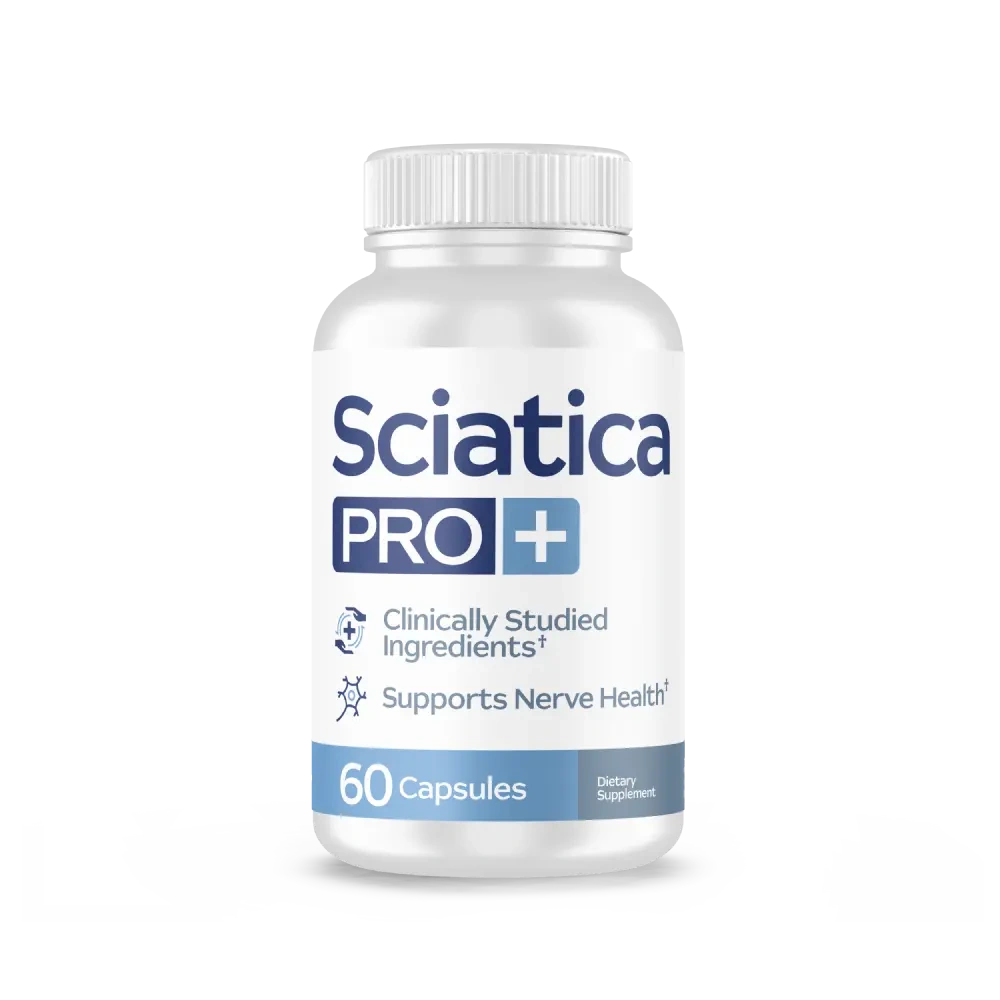
What Sciatica PRO+ actually is, in one panel
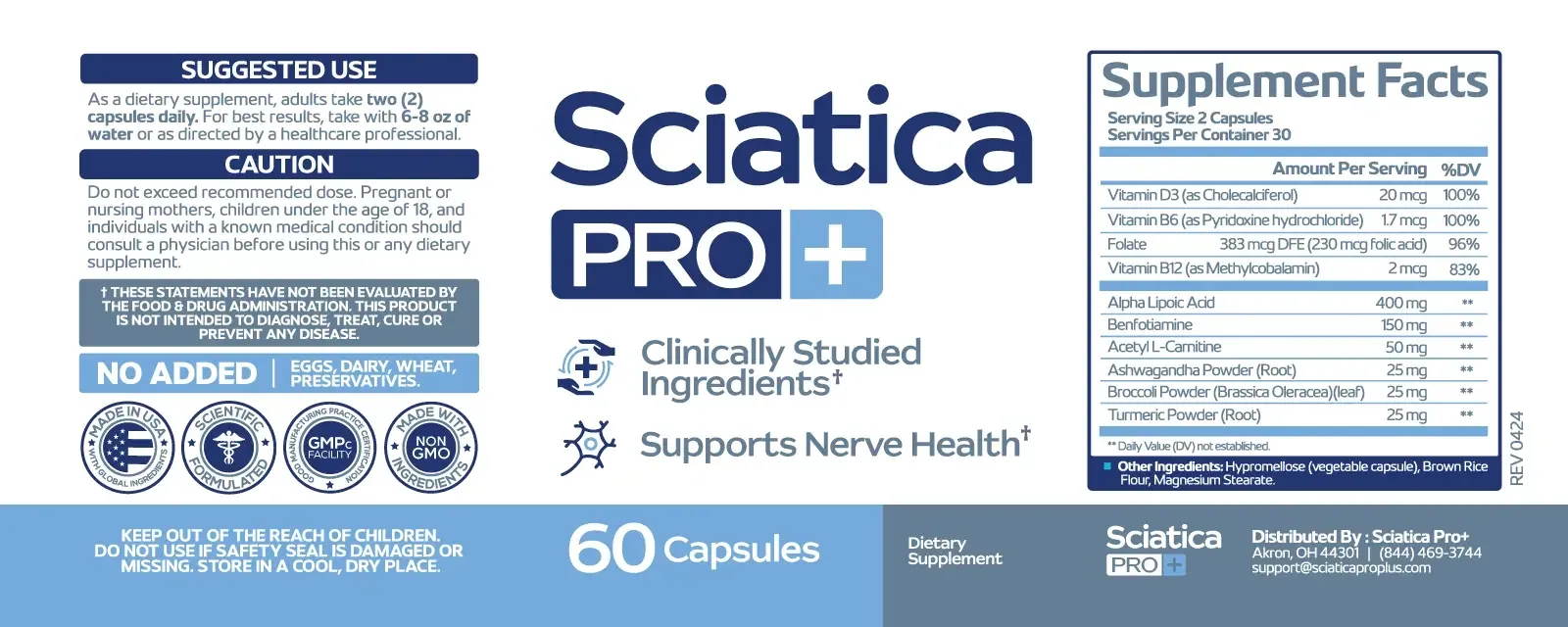
A ten-ingredient nerve-health capsule with an amount printed against every row. Two a day, 60 to a bottle, 60 days from purchase to change your mind. It is not a treatment for anything described on this page.
Packs from $158 · six bottles for $294 · 60-day money-back guarantee
Order Sciatica PRO+ On The Official WebsiteTwo capsules a day · 60 per bottle · lot SCI-26/GE-2574
Where surgery sits, and when
Surgery for sciatica is real, effective for the right person, and later in the sequence than most people assume. A 2023 meta-analysis of randomised trials found faster relief with surgery early on, with the advantage narrowing as the months passed.
It means the decision is usually about how quickly someone wants improvement rather than whether it will come at all, which makes it a conversation rather than an emergency.
The exceptions are the red flags above, and progressive weakness. Those change the timetable completely.
Why nutrition and compression are different subjects
A compressed nerve root is a physical situation: something inside the spine is sitting where it should not be. Relieving it means changing that situation, by time and the body's own resorption of the displaced material, by movement, or by an operation. A capsule dissolves in the stomach and enters the bloodstream, and nothing on that route reaches a disc and moves it.
What a capsule can reach
Nutrients matter to nerves in a real, well-documented way. Nerve cells run on the same metabolic machinery as everything else, and several vitamins are cofactors in it. A genuine deficiency of vitamin B12 damages nerves directly, and correcting it repairs measurable damage: the strongest link between nutrition and nerve function there is.
That is the territory a nerve supplement operates in: whether the nutritional inputs nerves require are adequate. The nerve health guide covers what the evidence supports across the category.
What it cannot reach
It cannot change where a disc sits. It cannot widen a narrowed canal. It cannot reduce the pressure on a root, and it is not an analgesic, so it does not block the pain that pressure produces.
That is not a criticism of this product specifically. It is true of every capsule, powder, gummy and tincture sold to people searching for the word sciatica.
What supports nerve health actually covers
A dietary supplement in the United States may make structure and function claims: what a nutrient is understood to do in the body, never naming a disease, and carrying the federal statement that they have not been evaluated by the Food and Drug Administration.
Supports nerve health is a claim of that kind. Relieves nerve pain is not, because pain relief is a drug claim whoever makes it.
- Inside the rules: supports normal nerve function; contains clinically studied ingredients; helps meet a daily requirement nerves need.
- Outside the rules: relieves sciatic pain; treats or reverses neuropathy; reduces inflammation around a nerve root; works in a stated number of days.
- The tell: where a sales page claims more than the bottle does, the bottle is the document written under legal constraint.
Clinically studied ingredients says the ingredients have been studied, not that this product was, and not that these amounts were. The ingredients page prints the trial dose beside every row so the difference is visible.
Five questions worth asking before buying anything
These five separate a product that might help from one selling you the word in your search box.
- Has the leg pain been assessed? If not, that comes first.
- Does the product claim to treat the condition, or to support a nutrient pathway? The first is a claim no supplement may make.
- Are the amounts printed? A shared blend total means no claim on the label can be checked.
- Does each amount match the dose its research used? This is where most nerve formulas come apart, and the checklist guide turns it into seven checks.
- What is the refund route, and how long is the window? A guarantee is a purchase policy rather than evidence.
What this website sells, said plainly
Sciatica PRO+ is a two-capsule-a-day nerve-health formula with ten named ingredients and an amount printed against each. Alpha lipoic acid at 400 mg is the largest, and it has the best nerve literature behind it. Four of the ten are vitamins at daily-requirement amounts. Four sit at amounts no trial has used.
If you have had your symptoms assessed, you want nutritional support for nerve function, and you read labels, this is a label that lets itself be read. If you are in pain and looking for relief, the honest answer is that this is not the product for that, and neither is any other capsule. Anyone misled upstream by an advertisement promising a schedule has the 60-day guarantee for exactly that situation.
References
- Jensen RK, Kongsted A, et al. Diagnosis and treatment of sciatica. BMJ. 2019;367:l6273. PMID 31744805. https://pubmed.ncbi.nlm.nih.gov/31744805/
- Ropper AH, Zafonte RD. Sciatica. N Engl J Med. 2015;372(13):1240-8. PMID 25806916. https://pubmed.ncbi.nlm.nih.gov/25806916/
- Bernstein IA, Malik Q, et al. Low back pain and sciatica: summary of NICE guidance. BMJ. 2017;356:i6748. PMID 28062522. https://pubmed.ncbi.nlm.nih.gov/28062522/
- Long B, Koyfman A, et al. Evaluation and management of cauda equina syndrome in the emergency department. Am J Emerg Med. 2020;38(1):143-148. PMID 31471075. https://pubmed.ncbi.nlm.nih.gov/31471075/
- Liu C, Ferreira GE, et al. Surgical versus non-surgical treatment for sciatica: systematic review and meta-analysis of randomised controlled trials. BMJ. 2023;381:e070730. PMID 37076169. https://pubmed.ncbi.nlm.nih.gov/37076169/
- MedlinePlus. Sciatica. U.S. National Library of Medicine. https://medlineplus.gov/sciatica.html