Sciatica PRO+ Official Website › How It Works
How It WorksHow Sciatica PRO+ Works: The Three Pathways
Sciatica PRO+ combines three ideas in one panel: nerve metabolism, daily vitamin needs and antioxidant support.
Two compounds support nerve metabolism, four vitamins meet ordinary daily needs, and four plant and amino compounds add antioxidant interest. It is not a painkiller.
Each pathway below is given its mechanism, its trial evidence and its limits, in that order.
How does Sciatica PRO+ work in the body?
Three mechanisms on one label, and it helps to take them apart before judging any.
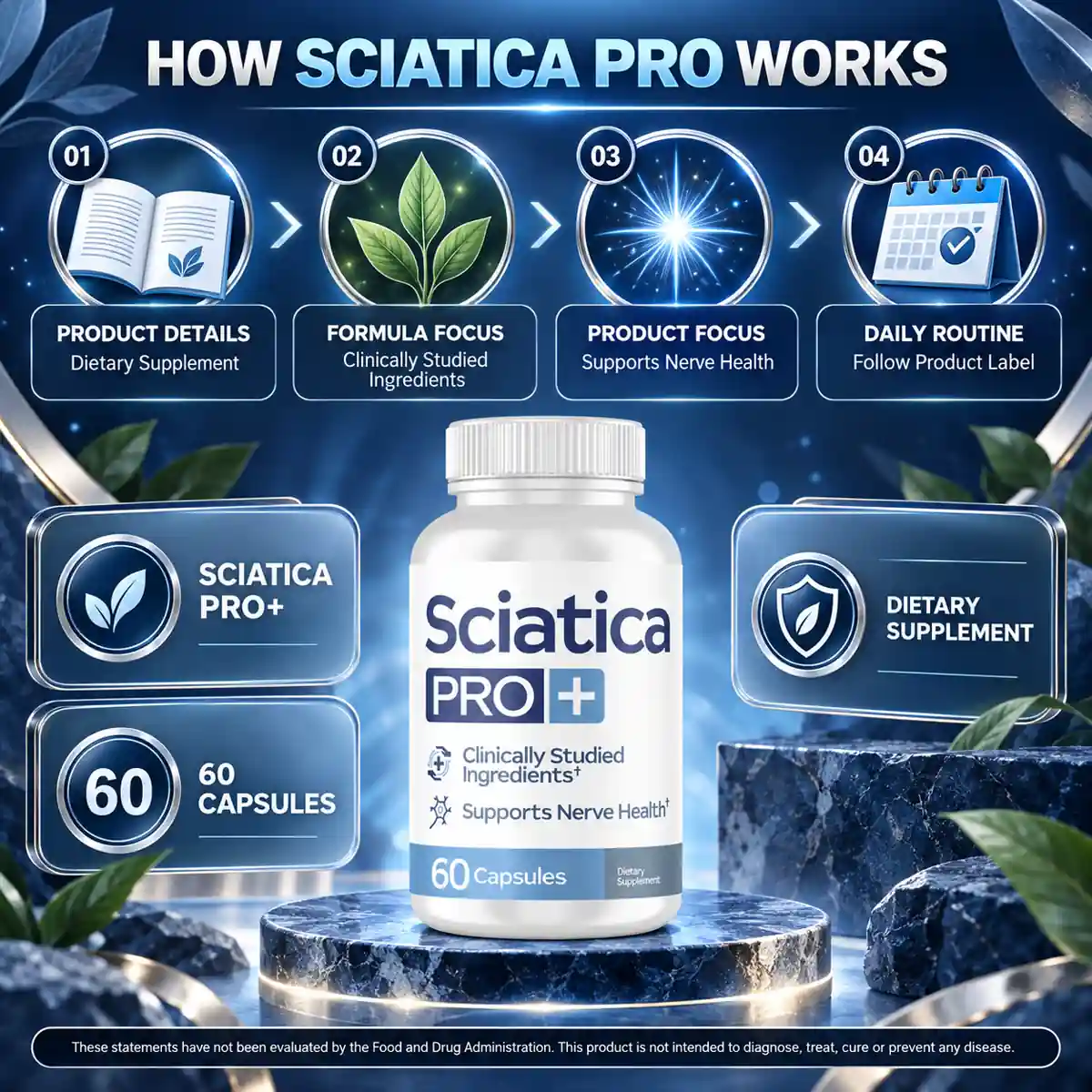
Three unrelated ideas share this panel, and reading them as one thing is how people end up disappointed. Separated, each has a mechanism that can be stated plainly and a weight of evidence that can be weighed.
The first is metabolic: two compounds with a worked-out rationale for protecting nerve tissue under oxidative and glucose stress, both studied in humans at specified doses. The second is nutritional: four vitamins that nerve tissue genuinely requires, supplied at the amount a day needs rather than at a therapeutic level. The third is antioxidant interest: four plant and amino compounds with their own literatures, none of them run at the amounts here.
What none of the three is, is a route to pain relief. Nothing on this label acts on a pain pathway, and nothing acts on the cause of the symptom this product is named after. Both statements hold whichever way you read the panel, and the section on limits below explains why.
Pathway one: Sciatica PRO+ and nerve metabolism
The largest two amounts on the label, and the only two with a mechanism worked out in advance.
Alpha lipoic acid and benfotiamine contribute 550 mg of the 675 mg serving, and they are the two rows a pharmacologist would look at first.
Alpha lipoic acid is a cofactor for the enzyme complexes that feed the citric acid cycle, and in supplement quantities it also mops up reactive oxygen species in both watery and fatty compartments of a cell. Nerve tissue is vulnerable to oxidative stress because it is long, metabolically busy and poorly supplied with repair capacity, which is the reasoning that put this compound into human trials. SYDNEY 2 reported improvement in symptom scores at 600 mg a day over five weeks, and a 2023 meta-analysis pooling the oral studies found the effect real but modest.
Benfotiamine works further upstream. Thiamine in its active form drives transketolase, an enzyme that pulls sugar intermediates out of three pathways implicated in glucose-driven tissue damage. Raise thiamine availability and, in theory, you divert traffic away from those pathways. Benfotiamine was engineered to raise it more effectively than thiamine salts, and BENDIP tested the idea at 300 and 600 mg a day.
Two honest qualifications. Both mechanisms were described in nerve damage caused by high blood glucose, not in nerve compression. And the 2026 review that examined the pair together is explicit that no study has demonstrated structural nerve regeneration from either, at any dose.
Pathway two: how Sciatica PRO+ covers a nutritional requirement
A requirement met is not an effect delivered, and the difference decides who this pathway reaches.
This is the pathway that makes the phrase on the bottle defensible, and it is also the least glamorous. Four vitamins, all of them genuinely required by nerve tissue, all of them at the amount a day calls for.
Vitamin B12 is the one that carries the argument. It is needed to build and maintain myelin, and a shortfall produces numbness, tingling and loss of position sense that the clinical literature describes as reversible if it is caught before the damage sets. Shortfalls are quietly common: absorption falls with age, plant-based diets supply almost none, and long-term metformin interferes with uptake, which a 2026 scoping review found clinicians frequently fail to monitor.
Folate and B6 sit alongside it in one-carbon and amino-acid chemistry, and vitamin D3 has an association with nerve symptoms that pooled observational studies have described without establishing which way it runs.
The mechanism here is simple and it has a hard edge. A requirement can only be met once. If your intake already covers it, adding more changes nothing, and the Cochrane review of B vitamins for nerve symptoms found the trial evidence too thin to claim otherwise. This pathway does something real for the person who was short and nothing at all for the person who was not.
Which raises the practical point. Whether you are short is a blood test, not a guess, and it costs less than a three-bottle pack.
Pathway three: the antioxidant rows on the Sciatica PRO+ label
Four mechanisms, each of which needs something the capsule does not supply.
Four ingredients, 125 mg between them, and four literatures that do not line up neatly with what is in the capsule.
Acetyl L-carnitine: a real mechanism at an unreal amount
It shuttles fatty acids into mitochondria and donates acetyl groups to nerve tissue chemistry, and the 52-week trials found improvement in pain and in nerve fibre regeneration at 3,000 mg a day. The mechanism is not in doubt. What is missing is any study at 50 mg, and mechanisms do not operate independently of quantity.
Ashwagandha: studied, but for something else
The randomised work measures stress and sleep, and the dose-response meta-analysis covers extracts at 300 to 600 mg. There is no ashwagandha trial with a peripheral nerve endpoint, so the pathway from this row to the claim on the bottle is a theoretical one.
Broccoli: a compound that has to be liberated first
Sulforaphane activates the Nrf2 antioxidant response, and a rat study showed that doing so reduced markers of diabetic nerve damage. In a dried powder the enzyme that liberates sulforaphane from its precursor is vulnerable to processing heat, so the mechanism has a step missing before it starts.
Turmeric: a mechanism gated by absorption
Curcumin has plausible antioxidant and anti-inflammatory activity in a dish, and almost no oral bioavailability without help. The one trial in diabetic nerve symptoms used a nano-formulated preparation for exactly that reason. Raw spice powder at 25 mg does not engage this pathway in any measurable way.
Set against the first two pathways, this group is where the label is at its thinnest. None of it is unsafe at these amounts and none of it is doing much either. The full arithmetic sits on the ingredients page.
What Sciatica PRO+ cannot do, and why the mechanism says so
The mechanism that matters most on this page is the one the product does not have.
Sciatica is pain running down the leg along the path the sciatic nerve takes, and the word names a symptom rather than a cause. Behind it, most often, is a lumbar disc pressing on a nerve root or a spinal canal narrowed with age. The BMJ clinical review and the New England Journal review both describe the assessment as clinical, built from history and examination rather than from scans in the first weeks.
Hold that mechanism beside the three pathways above and the conclusion arrives on its own. Pressure on a nerve root is a physical situation, and a swallowed capsule does not change a physical situation. Antioxidant activity inside a nerve cell does not make a disc retreat. Meeting a vitamin requirement does not widen a spinal canal.
There is also nothing here that blocks a pain signal. No compound on this panel acts at an opioid receptor, a sodium channel, a cyclo-oxygenase enzyme or anywhere else an analgesic works. Whatever this formula is, it is not a painkiller, and no amount of it becomes one.
The encouraging part of the evidence lies elsewhere. Most episodes settle over weeks to months given movement, time and ordinary conservative management, and surgery's advantage over that management narrows the longer it is left. Somebody who improves while taking a nerve-health capsule may simply have followed the usual course.
Whose body has something for Sciatica PRO+ to act on?
A mechanism only does something if there is something in you for it to do.
| Starting point | What the panel has to offer | How much of it applies |
|---|---|---|
| A confirmed B12 or vitamin D shortfall | Two rows meeting the daily requirement | The clearest case on the panel, though a diagnosed deficiency is corrected at far higher amounts under supervision |
| Nerve symptoms from long-term high blood glucose | The metabolic pathway, at two-thirds and one-half of trial amounts | The population every relevant trial enrolled, but not at these amounts |
| A vegetarian or vegan diet, or long-term metformin | B12 at 83 per cent of the daily value | A sensible nutritional cover, and a reason to have levels checked |
| An ordinary diet with no shortfall | Four vitamins meeting a requirement already met | Little to nothing, on the trial evidence |
| Leg pain from a disc or a narrowed canal | No mechanism addresses the cause | This is an assessment and a plan, not a supplement decision |
The right-hand column follows from the mechanisms above rather than from any claim made for this product.
The table is uncomfortable reading for a product sold under this name, and it is also the honest output of the three pathways. Two of the five rows describe someone the formula has something for. One describes a population the research studied at larger amounts. Two describe people who would be better served elsewhere.
If you are unsure which row you are in, who it is for turns the same question into a short decision test.
How a Sciatica PRO+ capsule delivers what is in it
What happens between swallowing the capsules and any of the above mattering.
Two capsules go down together with six to eight ounces of water, and the shell is hypromellose, which dissolves in the stomach within minutes and leaves the powder to disperse.
After that the four groups behave differently. Alpha lipoic acid is absorbed quickly and cleared quickly, with a plasma half-life measured in tens of minutes rather than hours, which is why the trials dosed it daily and why nausea, when it appears, arrives early. Benfotiamine's whole design is its fat solubility: it crosses cell membranes where water-soluble thiamine salts do not, which is what makes 150 mg of it a different proposition from 150 mg of thiamine hydrochloride.
The vitamins follow ordinary rules. D3 is fat-soluble and absorbs better alongside a meal containing some fat. B6, folate and B12 are water-soluble and the surplus leaves in urine, which is one reason these amounts are set at a daily requirement rather than a multiple of it.
The botanical powders face the problem described above: curcumin needs help to reach the bloodstream, and nothing in this capsule provides it. Taking the serving with food improves tolerance and does no harm to any of the four pathways. How to take it sets out the routine in full.
How strong is the evidence behind each Sciatica PRO+ pathway?
Three separate questions per row, because they come apart more often than not.
| Pathway | Mechanism described | Human trials exist | At this label's amount |
|---|---|---|---|
| Nerve metabolism: alpha lipoic acid | Yes, in detail | Yes, several, over months and years | Two-thirds of the studied amount |
| Nerve metabolism: benfotiamine | Yes, specific and biochemical | Yes, two randomised studies | Half the lower studied amount |
| Nutrient adequacy: B12 and folate | Yes, long established | Yes, in deficiency | A daily requirement, which is the right amount for the job |
| Nutrient adequacy: D3 and B6 | Yes | Few and small for D3; none for B6 alone | A daily requirement |
| Antioxidant: acetyl L-carnitine | Yes | Yes, at 1,500 to 3,000 mg | Three per cent of that |
| Antioxidant: ashwagandha, broccoli, turmeric | Yes, in laboratory terms | For other endpoints, other preparations | Below anything tested |
Three columns because those are three different questions, and a product can pass the first two while failing the third.
Two pathways are supported by human trials and supplied at amounts in the region of those trials or at the correct nutritional level. One pathway is mechanistically interesting and quantitatively absent. A buyer who understands that is buying the right thing for the right reason.
Who publishes this Sciatica PRO+ website?
- Ziegler D, Ametov A, et al. Oral treatment with alpha-lipoic acid improves symptomatic diabetic polyneuropathy: the SYDNEY 2 trial. Diabetes Care. 2006;29(11):2365-70. PMID 17065669. https://pubmed.ncbi.nlm.nih.gov/17065669/
- Hsieh RY, Huang IC, et al. Effects of Oral Alpha-Lipoic Acid Treatment on Diabetic Polyneuropathy: A Meta-Analysis and Systematic Review. Nutrients. 2023;15(16):3634. PMID 37630823. https://pubmed.ncbi.nlm.nih.gov/37630823/
- Stracke H, Gaus W, et al. Benfotiamine in diabetic polyneuropathy (BENDIP): results of a randomised, double blind, placebo-controlled clinical study. Exp Clin Endocrinol Diabetes. 2008;116(10):600-5. PMID 18473286. https://pubmed.ncbi.nlm.nih.gov/18473286/
- Ciubotaru A, Grosu C, et al. Alpha-Lipoic Acid and Benfotiamine in Diabetic Peripheral Neuropathy: A Critical Review of Mechanistic Rationale and Clinical Evidence Within a Nutritional Therapeutic Framework. Nutrients. 2026;18(10). PMID 42196997. https://pubmed.ncbi.nlm.nih.gov/42196997/
- Sima AA, Calvani M, et al. Acetyl-L-carnitine improves pain, nerve regeneration, and vibratory perception in patients with chronic diabetic neuropathy: an analysis of two randomized placebo-controlled trials. Diabetes Care. 2005;28(1):89-94. PMID 15616239. https://pubmed.ncbi.nlm.nih.gov/15616239/
- Akhgarjand C, Asoudeh F, et al. Does Ashwagandha supplementation have a beneficial effect on the management of anxiety and stress? A systematic review and meta-analysis of randomized controlled trials. Phytother Res. 2022;36(11):4115-4124. PMID 36017529. https://pubmed.ncbi.nlm.nih.gov/36017529/
- Negi G, Kumar A, et al. Nrf2 and NF-kB modulation by sulforaphane counteracts multiple manifestations of diabetic neuropathy in rats and high glucose-induced changes. Curr Neurovasc Res. 2011;8(4):294-304. PMID 22023613. https://pubmed.ncbi.nlm.nih.gov/22023613/
- Conaway CC, Getahun SM, et al. Disposition of glucosinolates and sulforaphane in humans after ingestion of steamed and fresh broccoli. Nutr Cancer. 2000;38(2):168-78. PMID 11525594. https://pubmed.ncbi.nlm.nih.gov/11525594/
- Anand P, Kunnumakkara AB, et al. Bioavailability of curcumin: problems and promises. Mol Pharm. 2007;4(6):807-18. PMID 17999464. https://pubmed.ncbi.nlm.nih.gov/17999464/
- Asadi S, Gholami MS, et al. Nano curcumin supplementation reduced the severity of diabetic sensorimotor polyneuropathy in patients with type 2 diabetes mellitus: A randomized double-blind placebo-controlled clinical trial. Complement Ther Med. 2019;43:253-260. PMID 30935539. https://pubmed.ncbi.nlm.nih.gov/30935539/
- Shoba G, Joy D, et al. Influence of piperine on the pharmacokinetics of curcumin in animals and human volunteers. Planta Med. 1998;64(4):353-6. PMID 9619120. https://pubmed.ncbi.nlm.nih.gov/9619120/
- Stabler SP. Clinical practice. Vitamin B12 deficiency. N Engl J Med. 2013;368(2):149-60. PMID 23301732. https://pubmed.ncbi.nlm.nih.gov/23301732/
- Parsonage I, Wainwright D, et al. Vitamin B12 deficiency in long-term metformin use and clinician awareness: a scoping review. BMJ Open. 2026;16(4):e113829. PMID 42009383. https://pubmed.ncbi.nlm.nih.gov/42009383/
- Ang CD, Alviar MJ, et al. Vitamin B for treating peripheral neuropathy. Cochrane Database Syst Rev. 2008;2008(3):CD004573. PMID 18646107. https://pubmed.ncbi.nlm.nih.gov/18646107/
- Yammine K, Abi Kharma J, et al. Is diabetic neuropathy associated with vitamin D status? A meta-analysis. Br J Nutr. 2022;127(7):972-981. PMID 34024290. https://pubmed.ncbi.nlm.nih.gov/34024290/
- Jensen RK, Kongsted A, et al. Diagnosis and treatment of sciatica. BMJ. 2019;367:l6273. PMID 31744805. https://pubmed.ncbi.nlm.nih.gov/31744805/
- Ropper AH, Zafonte RD. Sciatica. N Engl J Med. 2015;372(13):1240-8. PMID 25806916. https://pubmed.ncbi.nlm.nih.gov/25806916/
- Liu C, Ferreira GE, et al. Surgical versus non-surgical treatment for sciatica: systematic review and meta-analysis of randomised controlled trials. BMJ. 2023;381:e070730. PMID 37076169. https://pubmed.ncbi.nlm.nih.gov/37076169/
Order Sciatica PRO+ knowing which pathway you are buying
Two pathways with human trials behind them, one with laboratory interest only, and 60 days to decide whether any of it was worth it to you.
Packs from $158 · six bottles for $294 · 60-day money-back guarantee
Order Sciatica PRO+ On The Official WebsiteTwo capsules a day · 60 per bottle · lot SCI-26/GE-2574