Sciatica PRO+ Official Website › Blog › Folic acid and B12
Folic Acid And B12 In One Capsule: The Masking Problem
Two vitamins that appear together on thousands of panels have one specific interaction worth understanding before you swallow either. Folic acid can correct the anaemia of a vitamin B12 deficiency while the nerve damage from that deficiency carries on unnoticed.
- A vitamin B12 deficiency causes two separate problems: a blood problem and a nerve problem.
- Folic acid can correct the blood problem while the nerve problem continues.
- The blood problem is what a routine blood count picks up, so correcting it can remove the signal that prompts a test.
- Nerve damage from B12 deficiency is reversible early and less so the longer it runs.
- Anyone over 50, on long-term metformin, on acid-suppressing medicines, or eating no animal foods is in a higher-risk group.
- Unexplained numbness or tingling warrants a B12 test rather than blind supplementation.
Two vitamins that meet in one place
Folate and vitamin B12 are different nutrients doing different jobs, and they intersect at one specific reaction. Both are needed to convert one building block into another during the synthesis of DNA, which is why a shortage of either produces the same kind of anaemia: red blood cells that are fewer and larger than they should be.
That shared step is the reason the two are so often packaged together, and it is also the reason they interact in a way worth reading about. Being able to substitute for each other in one reaction does not make them interchangeable elsewhere.
Vitamin B12 has a second job that folate cannot cover, and that second job is about nerves.
What a B12 deficiency does to nerves
Beyond DNA synthesis, B12 is required for a reaction that keeps the myelin sheath around nerve fibres intact. Without enough of it, the insulation degrades, and the consequences are neurological rather than haematological.
The clinical review in the New England Journal sets out the picture: numbness and tingling, usually starting in the feet, unsteadiness on walking, loss of position sense, and in advanced cases cognitive changes. A BMJ clinical review covers the same ground for a general practice audience.
The important feature, for this article, is the timeline. Neurological damage from B12 deficiency responds well to treatment when it is caught early and less well the longer it has run. Months matter. That is what makes a delayed diagnosis a clinical problem rather than an administrative one.
How folic acid hides it
Here is the mechanism, in four rows.
| What a B12 deficiency does | Does folic acid affect it? |
|---|---|
| Causes a particular kind of anaemia, with enlarged red blood cells | Yes. Folic acid can correct this part, because the two vitamins meet in the same pathway for making DNA. |
| Damages the myelin sheath around nerves, producing numbness, tingling and unsteadiness | No. This part continues regardless. |
| Shows up on a routine blood count as the enlarged cells | That signal can disappear once folic acid is supplied, which is the whole problem. |
| Is reversible early and less so later | Which is why a delayed diagnosis matters rather than being merely untidy. |
A simplified account of a well-described clinical interaction. It is a reason to have a test rather than a reason to avoid folate, which is an essential nutrient.
Read the third row twice, because it is the crux. The enlarged red cells are the visible flag. They are what shows up on a routine blood count, prompt a clinician to ask why, and lead to a B12 test being ordered.
Supply enough folic acid and that flag can come down while the nerve damage carries on underneath. A review of the excess folic acid question works through the clinical implications and the evidence behind them.
Nobody is suggesting folate is harmful in itself. It is an essential nutrient and the fortification of flour with folic acid prevents serious birth defects. The point is narrower: in somebody who is short of B12 and does not know it, folic acid can remove the signal that would have led to finding out.
The four vitamin rows on the Sciatica PRO+ panel
D3, B6, folate and B12, all at daily-requirement amounts, with the figures printed so you can add them to anything else you take. Two capsules a day, 60 to a bottle, 60 days from purchase to decide.
Packs from $158 · six bottles for $294 · 60-day money-back guarantee
Order Sciatica PRO+ On The Official WebsiteTwo capsules a day · 60 per bottle · lot SCI-26/GE-2574
How much folic acid is actually in question
Scale matters here, and the honest answer is that the amounts on an ordinary supplement panel sit at the low end.
A review of the safe upper intake for the nervous system discusses the 1,000 mcg a day figure expert committees set for folic acid from supplements and fortified foods, and the reasoning behind it, which is precisely this masking question.
The risk is concentrated at high intakes over long periods, typically in people taking high-dose folic acid supplements on top of a fortified diet. A few hundred micrograms is a different situation from several thousand.
What does not scale down is the principle. Whatever the amount, the right response to unexplained numbness is a test rather than a guess, and that is true for somebody taking no supplements at all.
Who is at risk of being short
B12 comes from animal foods and has to be released from food protein by stomach acid before a specific carrier protein can absorb it in the small intestine. Every step in that chain is a place where things go wrong, which is why the risk groups look so varied.
- Adults over about 50. Stomach acid production falls with age, and less acid means less B12 released from food.
- Anyone eating no animal foods. Vegans, and long-term vegetarians eating very little dairy or egg. A fortified food or a supplement is the mainstream nutritional answer here.
- Long-term metformin users. A 2026 scoping review found the association well established and clinician awareness of it inconsistent, which makes it worth raising yourself.
- People on long-term acid-suppressing medicines. The same mechanism as age, by a different route.
- Anyone with gastric surgery, coeliac disease or Crohn's disease. Absorption happens in one specific part of the gut, and these change it.
- Pernicious anaemia. An autoimmune loss of the carrier protein itself, treated with injections rather than with a capsule.
Being on that list is a reason for a blood test rather than a reason to buy anything. A diagnosed deficiency is treated with doses far above what any supplement panel carries, under supervision, and sometimes by injection.
If you have numbness, tingling, pins and needles or unsteadiness that has not been explained, that is worth a blood test rather than a supplement. It is a simple test, and a B12 deficiency caught early is largely reversible. This applies whether or not you take anything from this website, and it applies with more force if you take folic acid from any source.
Why a test beats a guess
Three reasons, and the third is the one people find least intuitive.
A test tells you whether the problem is B12 at all. Numbness has a long list of possible causes and most of them are not nutritional, so guessing wrong costs time on a symptom where time matters.
A test sets the dose. A confirmed deficiency is treated at levels no supplement panel reaches, so somebody who has one and takes a multivitamin instead is undertreating a real condition.
And a test can be obscured by supplementing first. Starting B12 before the blood is taken can push a level into the normal range without addressing an absorption problem underneath it, which makes the result harder to interpret. Testing first is simply the more informative order.
And what the trials say if you are not deficient
The other half of the picture, and it is the half a supplement panel tends to leave out.
The Cochrane review of B vitamins for peripheral neuropathy assessed the trial evidence and found it too limited to support a recommendation. The studies were small, short and mixed in quality, and a clear benefit in people who were not deficient did not emerge.
So the accurate account of B vitamins and nerves has two halves that point in opposite directions. Correcting a genuine deficiency works and is well established. Taking extra when your levels are normal has not been shown to do anything.
That is a narrower claim than most nerve supplements make, and it is the claim the evidence supports. The nerve health guide works through the rest of the category on the same basis.
Reading this particular panel
Applied to the bottle this website sells, since that is the reason you are probably here.
| On this panel | Amount | For comparison |
|---|---|---|
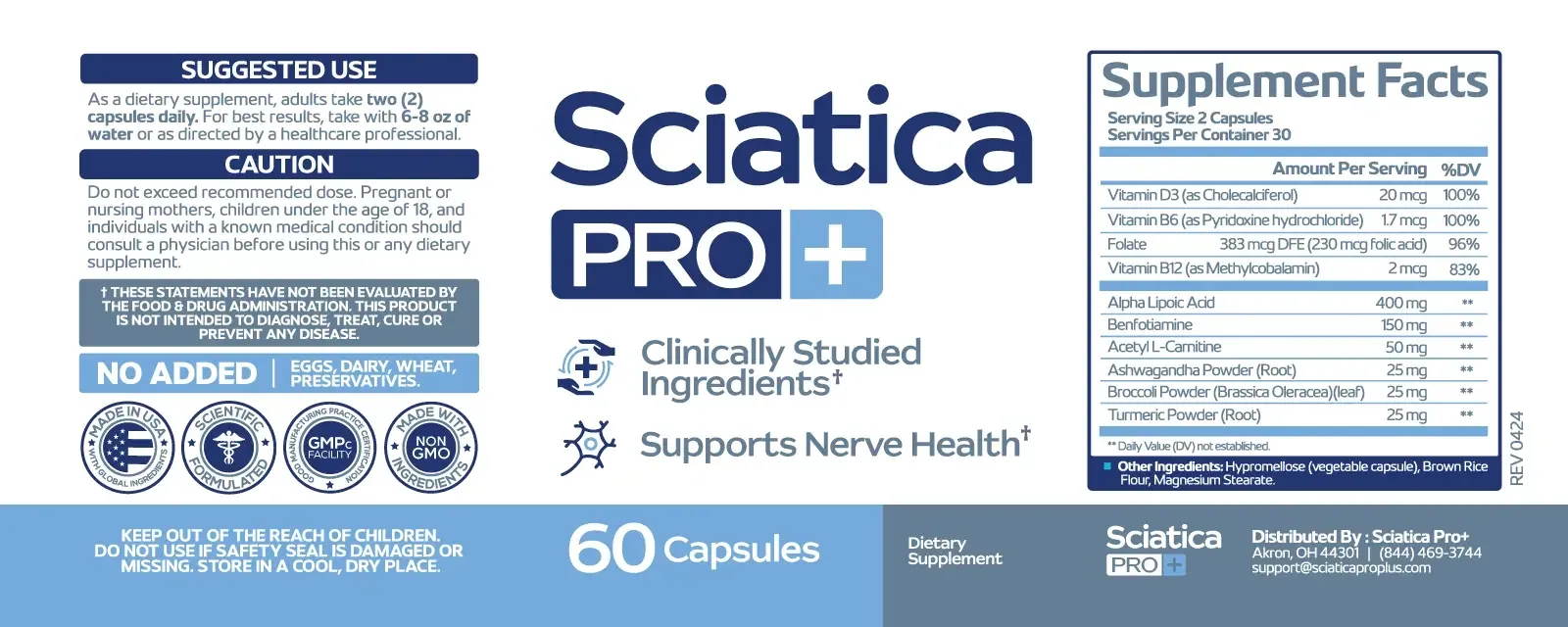
| Folate | 383 mcg DFE, as 230 mcg folic acid | Well under the 1,000 mcg a day upper intake level expert committees set for folic acid. |
| Vitamin B12 | 2 mcg (83% of the Daily Value) | An ordinary daily requirement. A diagnosed deficiency is treated far above this, under supervision. |
| Both together | In the same capsule | Which is the combination this article is about, and the reason it is worth reading before the first bottle. |
Read from the printed Supplement Facts panel. DFE means dietary folate equivalents, a unit that accounts for folic acid being absorbed more efficiently than food folate.
Three observations follow. The folic acid figure is well under the level at which the masking concern is usually discussed. The B12 figure is a daily requirement rather than a treatment dose. And the two do sit in the same capsule, which is why the interaction is printed on the disclaimer, on the side effects page and here rather than mentioned once and left.
The practical version for a reader: if your levels are fine, these two rows cover a requirement and that is all they do. If you have symptoms nobody has investigated, the panel is not the place to start.
What to do with all of this
- If you have unexplained numbness or tingling, ask for a B12 test. Before starting anything, because supplementing first makes the result harder to read.
- If you are in one of the risk groups above, mention it. Metformin in particular, since awareness of that association is patchy.
- Add up your folic acid from every source. A multivitamin, a fortified cereal and a separate B-complex stack, and the total is what matters rather than any one label.
- Treat a requirement amount as cover, not treatment. It fills a gap if you have one and does nothing measurable if you do not.
- Keep reading the panel rather than the front of the pack. The supplement facts page reproduces this one in full so you can hold it against the bottle that arrives.
References
- Miller JW, Smith A, et al. Excess Folic Acid and Vitamin B12 Deficiency: Clinical Implications? Food Nutr Bull. 2024;45(1_suppl):S67-S72. PMID 38987872. https://pubmed.ncbi.nlm.nih.gov/38987872/
- Reynolds EH. What is the safe upper intake level of folic acid for the nervous system? Implications for folic acid fortification policies. Eur J Clin Nutr. 2016;70(5):537-40. PMID 26862004. https://pubmed.ncbi.nlm.nih.gov/26862004/
- Stabler SP. Clinical practice. Vitamin B12 deficiency. N Engl J Med. 2013;368(2):149-60. PMID 23301732. https://pubmed.ncbi.nlm.nih.gov/23301732/
- Hunt A, Harrington D, et al. Vitamin B12 deficiency. BMJ. 2014;349:g5226. PMID 25189324. https://pubmed.ncbi.nlm.nih.gov/25189324/
- Parsonage I, Wainwright D, et al. Vitamin B12 deficiency in long-term metformin use and clinician awareness: a scoping review. BMJ Open. 2026;16(4):e113829. PMID 42009383. https://pubmed.ncbi.nlm.nih.gov/42009383/
- Ang CD, Alviar MJ, et al. Vitamin B for treating peripheral neuropathy. Cochrane Database Syst Rev. 2008;2008(3):CD004573. PMID 18646107. https://pubmed.ncbi.nlm.nih.gov/18646107/